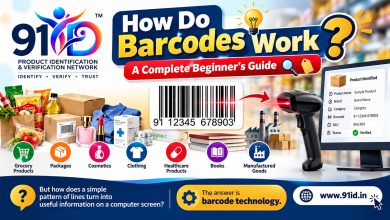
When you look at a product package, you may see a traditional barcode made of vertical black lines. You may also see a square-shaped QR Code.
Both can be scanned, but they are not the same technology and they are not always used for the same purpose.
Traditional retail barcodes such as EAN-13 and UPC-A are examples of 1D (one-dimensional) barcodes, while QR Codes are 2D (two-dimensional) symbols. GS1 explains that 1D barcodes use patterns of bars and spaces, while 2D barcodes encode data across both the width and height of the symbol.
So, what exactly is the difference?
🔍 What Is a Traditional Barcode?
A traditional barcode is a machine-readable representation of information using bars and spaces.
Some of the most familiar examples are:
- EAN-13
- UPC-A
- EAN-8
- UPC-E
- GS1-128
- ITF-14
For everyday retail products, EAN-13 and UPC-A are among the most widely used trade-item identification barcodes.
🏷️ Example
A typical EAN-13 barcode looks approximately like:
|||| ||| |||||| |||
Underneath it, you normally see a number such as:
8901234567890
The barcode is the machine-readable representation of the identifier.
The number itself identifies the product within the relevant identification system.
📱 What Is a QR Code?
A QR Code is a two-dimensional barcode made from small square modules arranged in a square pattern.
Unlike a traditional 1D barcode, information is encoded across both the horizontal and vertical dimensions.
QR Codes are now commonly used for:
- 🌐 Website links
- 📄 Digital information
- 📱 Mobile experiences
- 🎟️ Tickets
- 💳 Payments
- 📦 Product information
- 📣 Marketing campaigns
- 🔐 Verification systems
A smartphone’s standard camera can usually recognize a QR Code and open the associated content.
⚖️ Barcode vs QR Code: The Basic Difference
The easiest way to understand the difference is:
| Feature | Traditional Barcode | QR Code |
|---|---|---|
| Type | 1D | 2D |
| Appearance | Vertical bars | Square pattern |
| Data capacity | Generally lower | Generally higher |
| Common scanning device | Barcode scanner | Smartphone camera / image scanner |
| Common retail use | Product identification & POS | Digital information / consumer engagement |
| Can contain URLs | Generally not directly | Yes |
| Can hold additional data | Limited depending on symbol | Much more flexible |
| Smartphone-friendly | Depends on app | Usually very easy |
| Product identification | Yes | Can also identify products when designed for that purpose |
The important point is that QR Code is not simply a replacement word for barcode. QR Code is itself a type of 2D barcode.
📦 Why Are EAN-13 and UPC Called 1D Barcodes?
EAN-13 and UPC-A encode information using a pattern that runs primarily along one dimension—the widths and spaces of the bars.
This is why they are commonly called linear or 1D barcodes.
GS1 describes EAN/UPC as linear barcodes used widely for retail product identification.
🏪 Traditional Retail Example
A supermarket checkout may scan:
EAN-13 → GTIN → Product lookup → Price/Product record
The barcode itself generally does not contain the complete product description and price. The identifier can be used to retrieve associated information from a database.
🧩 Why Can QR Codes Store More Information?
A 1D barcode uses a series of bars and spaces.
A QR Code uses a two-dimensional matrix containing many individual modules.
This gives 2D symbols greater data capacity in a relatively compact area. GS1 notes that 2D barcodes can hold more data than 1D barcodes while remaining physically smaller.
This additional capacity can be used for things such as:
- Product identifiers
- Batch or lot information
- Expiration information
- Serial numbers
- URLs
- Digital product information
The exact data depends on how the QR Code is created and what standard or application is being used.
🌐 Can a QR Code Open a Website?
Yes.
This is one of the biggest practical differences customers notice.
A normal QR Code can encode a URL such as:
When the customer scans it, the smartphone can open that webpage.
This makes QR Codes particularly useful for connecting a physical product to digital information.
GS1’s QR Code with GS1 Digital Link can also connect product identification with web-based information and consumer experiences.
🔎 Does a QR Code Identify a Product?
It can—but it depends on what has been encoded and how the system is designed.
A generic QR Code might simply contain:
That does not necessarily identify a specific product.
A QR Code can, however, be designed as part of a product identification system.
For example:
QR Code → Product Identifier → Product Database → Product Information
In the GS1 system, a QR Code using GS1 Digital Link can carry a GTIN-based product identity and connect it to web information. GS1 specifically notes that a 2D barcode with GS1 Digital Link identifies the product; it does not merely identify the website.
🏷️ Barcode vs QR Code for Product Identification
For product identification, the important question isn’t simply:
“Which one is better?”
The better question is:
“What does the business need the code to do?”
Traditional Barcode
A traditional EAN/UPC barcode is highly established for retail product identification and point-of-sale workflows.
QR Code
A QR Code can provide product identification plus a connection to digital information, depending on implementation.
This makes QR Codes particularly useful when a brand wants to give customers access to richer information.
🛒 How Traditional Barcodes Work in Retail
Imagine a bottle on a supermarket shelf.
It has an EAN-13 barcode.
The checkout scanner reads the barcode:
Scan
⬇️
GTIN / Product Identifier
⬇️
Retail Database
⬇️
Product + Price
⬇️
Billing
This system has been fundamental to modern retail for decades.
GS1 describes EAN/UPC barcodes as widely used for price lookup and product identification at retail point of sale.
📲 How a QR Code Can Work With a Product
Now imagine the same product also has a QR Code.
A customer scans it using a smartphone:
Scan QR Code
⬇️
Product Web Page
⬇️
Product Information
The page could potentially provide:
- 📋 Product description
- 🧾 Ingredients
- 🌱 Sustainability information
- 🎥 Product videos
- 📖 Usage instructions
- ♻️ Recycling information
- 🏭 Brand information
- 🔍 Verification information
GS1 notes that 2D barcodes can connect physical products to richer digital information, including product details, traceability information and consumer-facing content.
🔐 Can QR Codes Be Used for Product Verification?
Yes, but the QR Code itself should not automatically be treated as proof that a product is genuine.
A QR Code is a data carrier.
The verification system behind it determines what can actually be checked.
For example:
QR Code
⬇️
Unique Product Identifier
⬇️
Verification Database
⬇️
Registered Product Record
This can create a useful product-verification workflow.
But simply copying a QR Code from one product onto another does not inherently prevent counterfeiting.
For stronger verification, businesses may use unique identifiers, serialisation, secure databases or other authentication mechanisms.
🌐 How 91iD™ Fits Into Product Identification
91iD™ is an independent/private product identification and verification system.
The 91iD™ system gives participating companies structured product identities that can be checked through the 91iD™ network.
Its identifier structure is:
91 + 7-digit Company ID + 3-digit Product ID + 1 Check Digit
For example:
91 | 1234567 | 001 | X
This creates a structured identity connecting:
Company → Product → Identifier → Verification Record
A barcode or QR Code can potentially be used as a visual/data carrier for an identifier, while the 91iD™ system provides the underlying product identity and verification layer.
⚠️ 91iD™ Is Not a GS1 GTIN
This distinction is important.
91iD™ identifiers are independent/private identifiers. They are not GS1 GTINs.
GS1 GTINs are part of the GS1 identification system and are used in retail and supply-chain environments where GS1 identification is required.
91iD™ has a different purpose: providing an independent product identification and verification network.
Therefore, if an Amazon listing, retailer, distributor or other system specifically requires a GS1 GTIN, businesses should use the appropriate GS1 identifier.
91iD™ can be used as an additional independent product identity and verification layer where appropriate.
🔄 Can a Product Have Both a Barcode and a QR Code?
Yes.
A product can carry multiple codes when each serves a different purpose.
For example:
EAN-13
➡️ Retail product identification / POS
QR Code
➡️ Customer access to digital information
This is particularly relevant during the industry’s transition toward greater use of 2D barcodes.
GS1 currently notes that not all retail systems can process 2D barcodes, and in some retail applications a 1D barcode is still needed during the transition.
🚀 Are QR Codes Replacing Traditional Barcodes?
The answer is not simply yes or no.
The industry is moving toward increased adoption of 2D barcodes, but traditional 1D barcodes remain important.
GS1’s retail guidance describes an industry ambition for retail point-of-sale systems to become capable of reading and processing both existing linear barcodes and 2D barcodes, with an initial global goal around the end of 2027.
So the future is likely to involve both technologies during the transition.
🧠 The Real Difference: Identification vs Digital Connection
One of the easiest ways to understand the two technologies is:
📦 Traditional Barcode
Identify → Look up → Process
📱 QR Code
Identify / Encode → Scan → Connect → Access Digital Information
However, this is a simplified comparison. Both 1D and 2D symbols can be designed for different applications, and modern 2D systems can also carry standardized product identifiers.
🏆 Which One Should a Business Use?
There is no universal answer.
The right choice depends on the business requirement.
🛒 If the main requirement is retail POS
A traditional retail barcode such as EAN-13 or UPC may be appropriate where that identification system is required.
📱 If the main requirement is consumer engagement
A QR Code can make it easy for smartphone users to access online information.
📦 If more product attributes need to be encoded
A suitable 2D barcode may provide significantly more data capacity than a traditional linear barcode.
🔍 If the goal is product verification
The important part is not just the visual symbol.
The business needs:
Identifier + Database + Verification System
The barcode or QR Code is the carrier.
💡 Barcode and QR Code Can Work Together
Instead of thinking of barcode and QR Code as competitors, businesses can think of them as different tools serving different functions.
A product could use:
EAN-13
for established retail identification
QR Code
for customer-facing digital information
91iD™
for an independent product identity and verification layer.
This combination can create a bridge between the physical product and its digital identity, provided each component is implemented appropriately.
🔮 The Future of Product Identification
The barcode industry is moving from simple identification toward richer digital connections.
Traditional 1D barcodes revolutionized retail by making product identification and automated checkout possible.
2D barcodes now make it possible to connect products with significantly more information and web-based experiences.
The evolution can be summarized as:
1D Barcode
➡️ Identify
2D Barcode
➡️ Identify + More Data
Connected 2D Barcode
➡️ Identify + Data + Digital Information
Product Verification Network
➡️ Identify + Verify + Connect
This is the direction in which modern product identity systems are developing.
🧾 Final Takeaway
The difference between a barcode and a QR Code is mainly about how data is encoded and what the code is designed to accomplish.
A traditional EAN-13 or UPC barcode is a 1D symbol widely used for product identification and retail processes.
A QR Code is a 2D symbol capable of carrying more data and connecting users to digital information such as websites and product experiences.
Neither technology is automatically “better” for every situation.
The right solution depends on the purpose:
🏷️ Retail Identification → Traditional Barcode
📱 Digital Information → QR Code
📦 Richer Product Data → 2D Barcode
🔍 Product Verification → Identifier + Database + Verification System
And for businesses looking for an independent product identity, 91iD™ provides a separate product identification and verification network that can complement existing barcode technologies.
❓ Frequently Asked Questions
1. Is a QR Code a barcode?
Yes. A QR Code is a type of 2D barcode/symbol. Traditional EAN-13 and UPC-A are examples of 1D barcodes.
2. Which stores more information, a barcode or QR Code?
Generally, a 2D QR Code can encode substantially more data than a traditional 1D barcode.
3. Can a QR Code identify a product?
Yes, if it is implemented to carry a product identifier or link to a system that identifies the product.
4. Can a barcode open a website?
Traditional EAN-13/UPC barcodes are primarily used to represent product identifiers. QR Codes are much more naturally suited to encoding URLs and connecting users to websites.
5. Can I use both EAN-13 and QR Code on one product?
Yes. They can serve different purposes, although exact requirements depend on the retail system and application. GS1’s current guidance specifically recognizes situations where 1D and 2D symbols are used together during the transition to 2D at retail.
6. Is 91iD™ a QR Code?
No. 91iD™ is a product identification and verification system. A barcode or QR Code can be used as a carrier for an identifier, while the 91iD™ system provides the underlying identity and verification layer.
7. Is 91iD™ a GS1 GTIN?
No. 91iD™ identifiers are independent/private identifiers and are not GS1 GTINs.
8. Will QR Codes replace all traditional barcodes?
Not immediately. 2D adoption is growing, but retail systems are still transitioning, and GS1 notes that many applications continue to require or support 1D barcodes.
🌐 Explore 91iD™
91iD™ — Independent Product Identification & Verification Network
Identify. Verify. Connect.