Every product has an identity.
A bottle of shampoo, a packet of rice, a mobile phone, a cosmetic product, a piece of clothing or a packaged food item may look completely different, but modern commerce needs one common thing:
A reliable way to identify each product.
That is where a Product Identifier comes in.
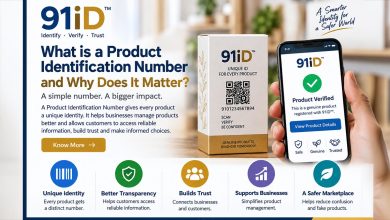
A product identifier is a unique or structured reference used to distinguish one product or product variant from another.
It helps businesses, retailers, marketplaces, warehouses and digital systems answer a simple question:
“Which exact product are we talking about?”
🧩 What Is a Product Identifier?
🔢 A digital identity for a product
A Product Identifier is a number, code or other structured identifier assigned to a product so that it can be distinguished from other products.
For example, a business may have:
- 🧴 Shampoo 100 ml
- 🧴 Shampoo 200 ml
- 🧴 Shampoo 500 ml
Although they belong to the same product family, they may need different identifiers because they are different product variants.
🏷️ Simple Example
Imagine a company sells three products:
Product A: Herbal Shampoo 100 ml
Product B: Herbal Shampoo 200 ml
Product C: Herbal Conditioner 100 ml
A product identification system can give each product its own identity:
| Product | Product Identifier |
|---|---|
| Herbal Shampoo 100 ml | ID-001 |
| Herbal Shampoo 200 ml | ID-002 |
| Herbal Conditioner 100 ml | ID-003 |
This makes it easier for computer systems to distinguish them.
🌐 Why Do Products Need an Identity?
🔍 Because names are not enough
Product names are useful for people, but they are not always reliable identifiers.
Different businesses may use similar names.
A product may also have:
- Different sizes
- Different colours
- Different flavours
- Different packaging
- Different formulations
- Different versions
A structured identifier helps systems distinguish these products.
📦 Product Identity = Product + Identifier
A simple way to understand the concept is:
Product
⬇️
Unique/Structured Identifier
⬇️
Digital Product Record
This connection allows physical products to interact with digital business systems.
🏪 Where Are Product Identifiers Used?
🛒 Retail
Retail stores use product identifiers to connect products with point-of-sale and inventory systems.
When a product is scanned at checkout, the identifier can be used to retrieve the relevant product record.
📦 Inventory Management
Warehouses can use identifiers to track:
- Stock received
- Stock stored
- Stock moved
- Stock dispatched
- Stock sold
🌐 E-commerce
Online marketplaces and e-commerce systems often use product identifiers to organize product listings and distinguish products.
🚚 Supply Chain
Manufacturers, distributors, warehouses and retailers need a common way to refer to products as they move through the supply chain.
📊 Business Analytics
Product identifiers can also help businesses connect sales, inventory and operational data to specific products.
🏷️ What Are Common Types of Product Identifiers?
🌍 GTIN
GTIN stands for Global Trade Item Number.
It is a family of standardized product identifiers used within the GS1 system.
Common formats include:
- GTIN-8
- GTIN-12
- GTIN-13
- GTIN-14
🇪🇺 EAN-13
EAN-13 is commonly used to refer to the 13-digit GTIN-13 format.
It is widely used for retail product identification.
🇺🇸 UPC-A
UPC-A is commonly associated with GTIN-12, a 12-digit format widely used in North American retail.
🖨️ Barcode
A barcode is a machine-readable representation of information.
For example, a GTIN can be represented in a suitable barcode symbol.
It is important to understand:
A barcode and a product identifier are not exactly the same thing.
The identifier is the data. The barcode is a machine-readable representation of that data.
🔎 Product Identifier vs Barcode
🧠 Think of It This Way
Product Identifier
= The identity/reference
Barcode
= The machine-readable representation
For example:
GTIN
⬇️
EAN-13 Barcode
⬇️
Barcode Scanner
⬇️
Retail System
The scanner reads the barcode and the system uses the decoded identifier to retrieve the relevant product information.
🧮 Why Does a Check Digit Matter?
✅ Error Detection
Many standardized product identifiers contain a check digit.
A check digit is calculated using a defined mathematical method.
Its purpose is to help identify certain errors in the identifier.
🔢 Example Concept
Suppose an identifier contains:
123456789012X
The final X can be a calculated check digit.
If the preceding digits are changed incorrectly, the resulting check digit may no longer match.
This provides a useful validation mechanism.
🧴 Why Does Every Product Variant Need Careful Identification?
📏 Different Sizes
A 100 ml product and a 200 ml product may need separate identification.
🎨 Different Variants
Different colours, flavours or versions may need separate product records.
📦 Different Packaging
A single item, multipack and case can represent different trade items depending on the business context.
🌍 Different Markets
Product identification requirements can vary depending on the market, retailer, marketplace and supply chain.
Therefore, businesses should not assume that one identifier automatically covers every product configuration.
🔗 How Does a Product Identifier Connect to a Database?
💻 Identifier → Record
A product identifier becomes particularly useful when it is connected to a digital record.
For example:
Product Identifier
⬇️
Database Search
⬇️
Product Record
⬇️
Product Information
The information displayed depends on the database or platform.
It could include:
- Product name
- Brand
- Product category
- Size
- Description
- Registration information
- Inventory information
- Other business data
🔍 Can a Product Identifier Prove Authenticity?
⚠️ Identification and authentication are different
This distinction is extremely important.
A product identifier tells a system which identifier is associated with a product record.
It does not automatically prove that the physical item is genuine.
🛡️ Authentication Requires More
A product authentication system may use additional information such as:
- Registration records
- Product data
- Serial numbers
- Security features
- Verification history
- Manufacturer information
Therefore:
Identification ≠ Authentication
But product identification can be an important component of a broader verification or authentication process.
🆔 What Is 91iD™?
🌐 Independent Product Identification & Verification
91iD™ is an independent product identification and verification network designed to give businesses a structured digital identity for their products.
The 91iD™ numbering architecture is:
91 + 7-Digit Company ID + 3-Digit Product ID + Check Digit
🔢 Example
91 1234567 001 X
Where:
- 91 = 91iD™ prefix
- 1234567 = Company ID
- 001 = Product ID
- X = Check Digit
This structure provides:
9,999,999 possible Company IDs
and
999 Product IDs per Company ID
giving a theoretical capacity of approximately:
9.99 billion product identities.
🔎 How Does 91iD™ Give a Product an Online Identity?
🌐 Product → 91iD™ ID → Online Record
A registered product can be associated with a digital record within the 91iD™ platform.
The basic concept is:
🏭 Company
⬇️
🆔 Company ID
⬇️
📦 Product
⬇️
🔢 Product ID
⬇️
🔍 91iD™ Identifier
⬇️
🌐 Online Product Record
This creates a structured connection between a physical product and its online identity.
🏢 Who Can Benefit From Product Identification?
🏭 Manufacturers
Manufacturers can organize products and product variants using structured identifiers.
🌱 Small & Local Businesses
Small businesses can create a digital identity for products and make product information easier to organize.
🛍️ E-commerce Sellers
Online sellers can connect product records with their digital product catalogue.
📦 Distributors
Distributors can use product identifiers to organize product information across their operations.
👥 Customers
Customers can use available online product information to learn more about a registered product and, where supported, verify its associated record.
⚠️ 91iD™ and GS1 GTIN Are Different
📌 An important distinction
91iD™ should not be described as a GS1-issued GTIN.
GS1 GTINs belong to the GS1 identification system.
91iD™ is an independent product identification and verification system with its own numbering architecture.
A business should always check the specific requirements of:
- Marketplace
- Retailer
- Distributor
- Supply chain
- Export market
- Target country
before deciding which product identifier it needs.
📊 Product Identifier vs Barcode vs 91iD™
🧠 Quick Comparison
| Concept | Purpose |
|---|---|
| Product Identifier | Identifies or references a product |
| GTIN | Standardized trade-item identifier family |
| EAN-13 | GTIN-13 format commonly used for retail |
| UPC-A | GTIN-12 format commonly associated with North America |
| Barcode | Machine-readable representation |
| 91iD™ | Independent product identification & verification system |
🚀 Why Product Identification Matters in Modern Commerce
🔗 Connecting Physical and Digital Products
Modern commerce increasingly connects physical products with digital information.
A product may exist on:
- 🏪 Retail shelves
- 📦 Warehouse systems
- 🛒 E-commerce websites
- 📱 Mobile applications
- 🚚 Distribution systems
- 💻 Business databases
A reliable identifier helps these systems refer to the correct product.
📈 Better Data Organization
Structured identifiers can help businesses organize large product catalogues.
Instead of relying only on product names, businesses can use consistent identifiers to distinguish products.
🔍 Easier Product Search
When an identifier is searchable, users and systems can find the corresponding product record more efficiently.
This is one of the principles behind 91iD™.
❓ Frequently Asked Questions
What is a product identifier?
A product identifier is a number, code or structured reference used to distinguish a product or product variant from other products.
Why does a product need an identifier?
Identifiers help businesses and digital systems distinguish products, organize inventory, manage catalogues and connect physical products with digital records.
Is a barcode a product identifier?
Not exactly. A barcode is a machine-readable representation. The data encoded by the barcode may be a product identifier such as a GTIN.
What is GTIN?
GTIN stands for Global Trade Item Number and refers to a family of standardized trade-item identification formats.
Is EAN-13 a GTIN?
Yes. EAN-13 is commonly associated with the GTIN-13 format.
Is UPC a GTIN?
UPC-A corresponds to GTIN-12.
Does every product variant need a different identifier?
Depending on the identification system and business context, different product variants may require different identifiers. Businesses should follow the requirements applicable to their market and trading partners.
Can a product identifier prove authenticity?
No. Identification and authentication are different concepts. A product identifier can support a verification system, but an identifier alone does not prove that a physical product is genuine.
What is 91iD™?
91iD™ is an independent product identification and verification network that provides structured digital product identities.
How does 91iD™ identify products?
91iD™ uses a numbering architecture containing a 7-digit Company ID, 3-digit Product ID and check digit, together with the 91iD™ prefix.
How can I learn more about 91iD™?
Visit 91id.in to explore the 91iD™ product identification and verification platform.
🌐 Final Takeaway
🆔 Every Product Needs a Clear Identity
A product name tells us what something is called.
A product identifier tells a system which product it is.
A barcode provides a convenient way for machines to capture that identifier.
And a digital product record can connect that identifier with useful product information.
The overall relationship can be understood as:
🏭 Product
⬇️
🆔 Product Identifier
⬇️
🏷️ Barcode / Machine-readable representation
⬇️
📷 Scanner or Digital Search
⬇️
💻 Product Database
⬇️
🔍 Product Information & Verification
For businesses looking for an independent approach to digital product identity and online verification, 91iD™ at 91id.in provides a dedicated product identification network.
🚀 Explore 91iD™
91iD™ | Independent Product Identification & Verification