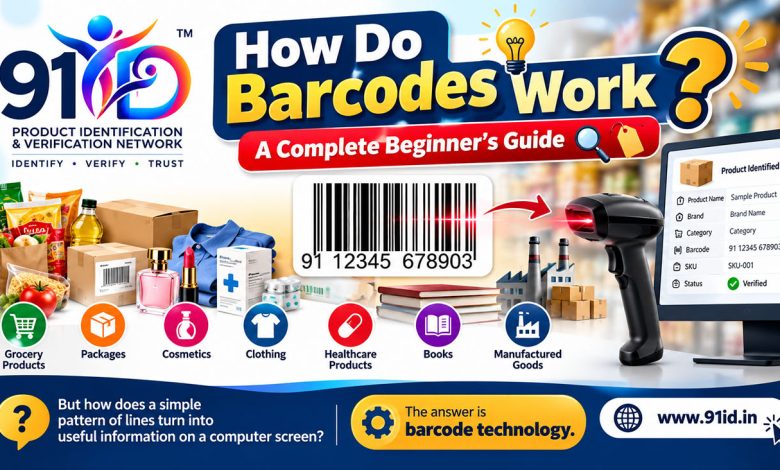
- A Complete Beginner’s Guide | 91iD™
Have you ever wondered what those black-and-white lines on a product actually mean?
You see them on almost everything:
🛒 Grocery products
📦 Packages
💄 Cosmetics
👕 Clothing
💊 Healthcare products
📚 Books
🏭 Manufactured goods
But how does a simple pattern of lines turn into useful information on a computer screen?
The answer is barcode technology.
In this beginner’s guide, we will explain how barcodes work, what information they contain, how scanners read them, what EAN-13 and UPC-A mean, and how modern product identification systems such as 91iD™ can connect a product identifier with online product information.
🏷️ What Is a Barcode?
🔎 A barcode is a machine-readable representation of information
A barcode is a visual pattern that allows a scanner or imaging device to capture information electronically.
Traditional 1D barcodes use combinations of dark bars and light spaces.
The scanner reads the pattern and converts it into digital data that a computer system can process.
According to GS1, barcodes use patterns of bars and spaces to represent information and are widely used for automatic identification and data capture.
💡 Simple Example
Think of a barcode as a visual language for machines.
A person sees:
▌▌ ▌ ▌▌▌ ▌▌ ▌
A barcode scanner sees a structured pattern that can be decoded into data.
That data can then be used by a retail or business system to look up information about the product.
🧩 How Does a Barcode Work?
🔄 The basic process
The process can be simplified into five steps:
Product → Identifier → Barcode → Scanner → Database/System
Let’s understand each step.
1️⃣ A product receives an identifier
A product is assigned an identification number.
For example, a GS1 trade item may have a GTIN.
A GTIN is used to uniquely identify a trade item so that systems can look it up in a database.
2️⃣ The identifier is converted into a barcode
The number can be represented using an appropriate barcode symbology.
For example:
GTIN-13 → EAN-13 barcode
or
GTIN-12 → UPC-A barcode
EAN-13 and UPC-A are among the most widely used barcodes for retail trade-item identification.
3️⃣ The barcode is printed
The barcode can be printed on:
📦 Packaging
🏷️ Labels
🧴 Bottles
📄 Product stickers
🛍️ Retail packaging
4️⃣ A scanner reads the barcode
A barcode scanner uses optical technology to detect the pattern of bars and spaces.
Depending on the scanner type, it may use laser-based or image-based technology.
5️⃣ The system processes the decoded information
The scanner sends the decoded data to a connected computer or software system.
That system can then use the identifier to find the corresponding product record.
🔦 How Does a Barcode Scanner Read the Lines?
💡 Light + Contrast + Pattern
Traditional 1D barcode scanners need to distinguish between dark bars and light spaces.
The contrast creates a measurable pattern.
The scanner captures that pattern and the decoding software interprets it according to the barcode’s rules.
GS1 explains that scanners read the spaces and bars and use the structure of the symbol to decode the information.
🧠 Think of It Like Morse Code
A useful beginner analogy is Morse code.
Morse code uses combinations of dots and dashes.
A barcode uses combinations of bars and spaces.
The patterns are different, but the basic idea is similar:
Pattern → Interpretation → Information
🖥️ What Happens After Scanning?
📲 The barcode does not automatically contain your product database
This is an important concept.
A barcode scanner generally captures the encoded identifier.
The connected software can then use that identifier to find the corresponding record.
For example:
Scanner
⬇️
1234567890123
⬇️
Product Database
⬇️
Product Name + Product Information + Price + Inventory
The actual information displayed depends on the database and software connected to the scanner.
🔍 Why Is This Important?
The number itself may not tell you the product name or price.
Instead, the identifier acts as a key for looking up information.
GS1 notes that the GTIN itself does not contain meaningful product details that can simply be decoded without access to a database.
🔢 What Information Is Inside a Barcode?
🏷️ It depends on the barcode type
Not every barcode stores the same type or amount of information.
Some traditional retail barcodes are designed primarily to represent a product identifier such as a GTIN.
Other barcode formats can carry additional information.
🛒 EAN-13 and UPC-A
EAN-13 and UPC-A are commonly used to represent GTINs for retail products.
They are primarily used for trade-item identification.
📦 More Advanced Barcodes
Other barcode systems can encode additional information such as:
- 🔢 Product identifiers
- 📦 Batch or lot numbers
- 📅 Expiration dates
- 🔐 Serial numbers
- 🚚 Logistics information
GS1 barcode technologies such as GS1-128, GS1 DataMatrix and GS1 QR Code can support additional attributes using GS1 Application Identifiers.
🧮 What Is a Barcode Check Digit?
✅ A mathematical validation digit
Many product identification numbers contain a check digit.
The check digit is calculated using a defined algorithm.
Its purpose is to help detect certain errors in the identifier.
For example, if someone accidentally enters a digit incorrectly, the check-digit calculation may identify that the number is not structurally valid.
🔢 Why Is It Useful?
A check digit helps improve data accuracy during:
- 🖥️ Data entry
- 🔍 Verification
- 🛒 Scanning
- 📦 Inventory operations
GS1 identifies the check digit as part of the GTIN structure and uses a defined check-digit algorithm.
⚪ What Is the Quiet Zone?
👀 The empty space around a barcode
Look closely at a properly printed barcode.
There is normally clear space around the symbol.
This area is called the Quiet Zone.
It helps the scanner distinguish the barcode from surrounding printed material.
⚠️ Why Does Quiet Zone Matter?
If text, graphics, borders or other printed elements interfere with the required clear area, scanning performance can be affected.
GS1 specifically identifies insufficient Quiet Zones as a common barcode-quality problem.
So when designing packaging:
Don’t crowd the barcode.
Give it enough clear space to be read correctly.
🖨️ What Makes a Barcode Easy to Scan?
✅ Good barcode practices
A barcode needs more than just the correct number.
Important factors include:
- ✔️ Correct check digit
- ✔️ Adequate contrast
- ✔️ Correct symbol size
- ✔️ Proper barcode height
- ✔️ Sufficient Quiet Zone
- ✔️ Good print quality
- ✔️ Suitable placement
- ✔️ Undamaged packaging
GS1’s barcode-quality guidance highlights these factors because poor printing, insufficient contrast, damaged symbols and incorrect positioning can reduce scanning performance.
🎨 Does Barcode Colour Matter?
Yes.
A barcode needs sufficient contrast between the bars and the background.
The safest general approach is a strong contrast between dark bars and a light background.
📊 What Are 1D and 2D Barcodes?
1️⃣ 1D Barcodes
Traditional barcodes use a single direction of information.
Examples include:
- EAN-13
- UPC-A
- EAN-8
- UPC-E
- ITF-14
These are commonly called linear barcodes.
2️⃣ 2D Barcodes
Two-dimensional barcodes use patterns across both width and height.
Examples include:
- QR Code
- Data Matrix
- GS1 DataMatrix
2D symbols can hold more data than traditional 1D symbols in a relatively compact area.
🔍 Simple Difference
1D Barcode
||||||||||||||||
2D Barcode
▦
A 1D barcode primarily uses bars and spaces along one dimension.
A 2D barcode uses a two-dimensional pattern.
🛒 How Are Barcodes Used in Retail?
💳 Point-of-Sale Scanning
When you take a product to a checkout counter, the barcode can be scanned.
The retail system receives the identifier.
It can then retrieve information such as:
- Product description
- Price
- Inventory status
- Sales information
📦 Inventory
Businesses can scan products when they:
- Receive stock
- Move inventory
- Count stock
- Dispatch products
- Sell products
This reduces manual data entry.
🚚 Supply Chain
Barcodes also help businesses identify products as they move through manufacturing, distribution, warehousing and retail.
GS1 describes barcodes as an important part of automatic identification and data capture across supply chains.
🌐 How Do Barcodes Connect the Physical and Digital Worlds?
🔗 Product → Number → Data
This is where product identification becomes particularly powerful.
A physical product can have:
Physical Product
⬇️
Unique Identifier
⬇️
Barcode
⬇️
Scanner
⬇️
Digital System
⬇️
Product Information
The barcode acts as a bridge between the physical product and digital information.
🆔 How Does 91iD™ Fit Into Product Identification?
🌐 Independent Product Identification & Verification
91iD™ takes the concept of product identification into an online verification environment.
The 91iD™ identification architecture is:
91 + 7-Digit Company ID + 3-Digit Product ID + Check Digit
For example:
91 1234567 001 X
Where:
- 91 = 91iD™ prefix
- 1234567 = Company ID
- 001 = Product ID
- X = Check Digit
🔍 What Happens With a 91iD™ Product?
A registered 91iD™ product can have a corresponding online product identity.
A user can search the identifier through the 91iD™ platform and access the product information associated with that registered record.
🌐 Visit 91iD™
Businesses interested in independent product identification and verification can explore:
91id.in
⚠️ 91iD™ Is Not a GS1 GTIN
It is important to keep the distinction clear.
91iD™ is an independent product identification and verification system.
It is not a GS1-issued GTIN and should not be represented as one.
Businesses selling through retailers, marketplaces or international supply chains should check the specific identifier requirements applicable to their products.
🔐 Can a Barcode Prove That a Product Is Genuine?
⚠️ Not by itself
This is another important misconception.
A barcode is primarily a way to represent machine-readable data.
Simply scanning a barcode does not automatically prove that a physical product is genuine.
🔎 Verification Requires More Information
A verification system may connect the identifier to information such as:
- Company
- Product
- Product description
- Registration record
- Status
- Other relevant product information
This is where an online product verification platform can provide additional value.
🆔 91iD™ Product Verification
With 91iD™, the product identifier can be connected to an online product record.
This creates a pathway:
Product → 91iD™ Identifier → Online Record → Verification
📱 Can a Smartphone Scan a Barcode?
📷 Yes, depending on the barcode and application
Modern smartphones can use their cameras and compatible applications to read many barcode formats.
QR codes are particularly convenient because smartphone camera applications commonly support them.
Dedicated barcode-scanning applications can also read many 1D formats.
However, the ability to scan a symbol does not necessarily mean that every scanner or system can process every barcode type in every environment.
GS1 notes that scanner capabilities vary, particularly between 1D and 2D scanning technologies.
🏭 Why Do Businesses Need Product Identification?
📦 Manufacturers
Product identifiers help manufacturers distinguish products and variants.
🛍️ Retailers
Retailers can connect products with inventory and point-of-sale systems.
🌐 E-commerce Sellers
Online sellers may need product identifiers depending on the marketplace and product category.
🚚 Distributors
Distributors can use identifiers throughout receiving, storage and dispatch processes.
👥 Customers
Customers can use available product information to learn more about a product and, where supported, verify its associated record.
❓ Frequently Asked Questions
What is a barcode?
A barcode is a machine-readable representation of information using a structured visual pattern.
How does a barcode scanner work?
A scanner captures the barcode’s visual pattern and decoding software converts that pattern into digital data.
Does a barcode contain the product price?
Not necessarily. In many retail applications, the barcode represents a product identifier and the connected system retrieves the price from a database.
Is a barcode the same as a GTIN?
No.
A GTIN is an identifier, while a barcode is a machine-readable representation that can encode the identifier.
What is EAN-13?
EAN-13 is a 13-digit barcode format commonly used to represent a GTIN-13 for retail products.
What is UPC-A?
UPC-A is a 12-digit barcode format commonly used to represent a GTIN-12.
What is a 2D barcode?
A 2D barcode stores information using a two-dimensional pattern of squares, dots or other elements.
What is a Quiet Zone?
The Quiet Zone is the clear area around a barcode that helps scanners distinguish the symbol from surrounding material.
Can a barcode prove product authenticity?
Not automatically. Authentication requires a suitable verification process and trustworthy product information.
What is 91iD™?
91iD™ is an independent product identification and verification network that provides structured digital product identities.
Where can I learn more about 91iD™?
Visit 91id.in to learn about 91iD™ product identification and verification.
🚀 Final Takeaway
🔍 The Barcode Is More Than a Pattern
A barcode is a bridge between a physical product and a digital system.
The basic process is:
🏷️ Product
⬇️
🔢 Identifier
⬇️
🖨️ Barcode
⬇️
📷 Scanner
⬇️
💻 Digital System
⬇️
📋 Product Information
Modern product identification goes beyond simply printing black lines on packaging.
It is about creating reliable connections between products, identifiers, databases and digital information.
For businesses exploring independent product identification and online verification, 91iD™ at 91id.in provides another approach to creating searchable digital product identities.
🌐 Explore 91iD™
91iD™ | Independent Product Identification & Verification